
SELF-DRIVE IN AFRICA
Freedom on four wheels
A safari doesn't always have to start with a guide in an open safari vehicle.
Sometimes it begins the moment you are behind the wheel, leaving the last houses behind you and facing nothing but an endless gravel road.
Nothing but landscape to the left and right. Perhaps an oryx by the roadside. A herd of elephants in the distance. A sign telling you that the next gas station is several hundred kilometers away.
Self-drive means freedom.
You set your own pace, decide when to stop, and can design a journey to suit you.
But self-drive in Africa is not simply comparable to a European road trip.
Depending on where you are traveling, you can expect asphalt roads, corrugated tracks, deep sand, potholes, river crossings or kilometers of gravel roads.
And that's precisely why proper preparation is crucial.
At InfiniteWild, we currently plan self-drive tours primarily in Namibia, South Africa, and Botswana. We differentiate very carefully between these three countries.
In Namibia, you can embark on a self-drive trip relatively easily.
In South Africa, self-drive is particularly flexible and also well suited for beginners.
Botswana, on the other hand, is a different league: Here we require 4x4 experience or appropriate instruction and training.
We don't just plan a route.
We look at which vehicle, route, accommodation and driving experience are a good match.

What does "self drive" actually mean?
Self-drive does not necessarily mean camping with us.
You can plan your trip in many different ways.
Lodge or boutique hotel safari
You travel from accommodation to accommodation yourself and stay overnight in lodges, hotels or guesthouses.
This is the most comfortable option and is particularly suitable if you want to explore Africa on your own, but don't want to camp yourself.


Rooftop tent safari
You have your entire home with you on the roof of your 4x4.
In the evening you go to your campsite, set up your rooftop tent and sleep surrounded by nature.
This is much more original and independent.
The combination
For us, often the most exciting option.
Some nights in a rooftop tent, others in a lodge.
This way you get the feeling of a real road trip without having to sacrifice comfort.
For example, you could camp for several days and then spend two nights in a nice lodge to recharge.

Which countries are suitable for self-drive holidays?
From our portfolio, we currently offer Self Drive primarily in three countries:
Namibia, South Africa and Botswana.
There's a good reason for that:
Self-drive doesn't work equally well everywhere in Africa.
A destination may be scenically perfect, but due to road conditions, infrastructure, distances, safety aspects or lack of reliable breakdown assistance, it may still not be suitable for a completely self-driven trip.
We don't want to simply offer you a rental car everywhere.
We want to offer you a route that actually works.
Namibia: The ultimate self-drive country
If you're planning your first extended self-drive holiday in Africa, Namibia is probably the destination we'd recommend first. Namibia is exceptionally well-equipped for self-drivers. The Namibia Tourism Board describes self-drive as one of the most popular ways to explore the country. At the same time, around 80 percent of the road network consists of gravel roads. These are generally well-maintained, but require significantly more time than paved roads.
And that's precisely the point: Namibia is easy to travel through, but not quick. A route that looks harmless on the map can take several hours.
The roads in Namibia
You will experience different types of roads in Namibia:
Asphalt: The major connecting roads are mostly well-maintained. You can drive here relatively relaxed.
Gravel: This is the norm on many tourist routes. The quality can vary greatly. A so-called gravel road can be wonderfully smooth. Or made of corrugated iron. Or loose gravel. Or suddenly riddled with deep potholes.
Sand: In some regions, especially off the main roads, sand can become a real driving challenge. The right vehicle and the right driving technique are crucial here.
Off-road: True 4x4 tracks are a different story altogether. If you lack the necessary experience, you shouldn't attempt such sections on your own. The Namibia Tourism Board also recommends appropriate experience or a guided 4x4 tour for challenging off-road driving.
Why we recommend a 4x4 in Namibia
You can also travel through parts of Namibia with a regular vehicle.
However, we still recommend a 4x4 for most of our self-drive tours.
Not because every road needs all-wheel drive.
But because of:
higher ground clearance
more stable construction
better suited tires
More riding comfort on gravel roads
better traction
larger storage space
increased safety on long journeys
More options for remote accommodations
The Namibia Tourism Board also points out that a robust 4x4 can be particularly useful because of ground clearance, safety and performance reserves.


Botswana: Self-Drive for Advanced Drivers
Botswana is fantastic.
But Botswana is also the country in our portfolio where we take a much closer look at self-drive options.
Why?
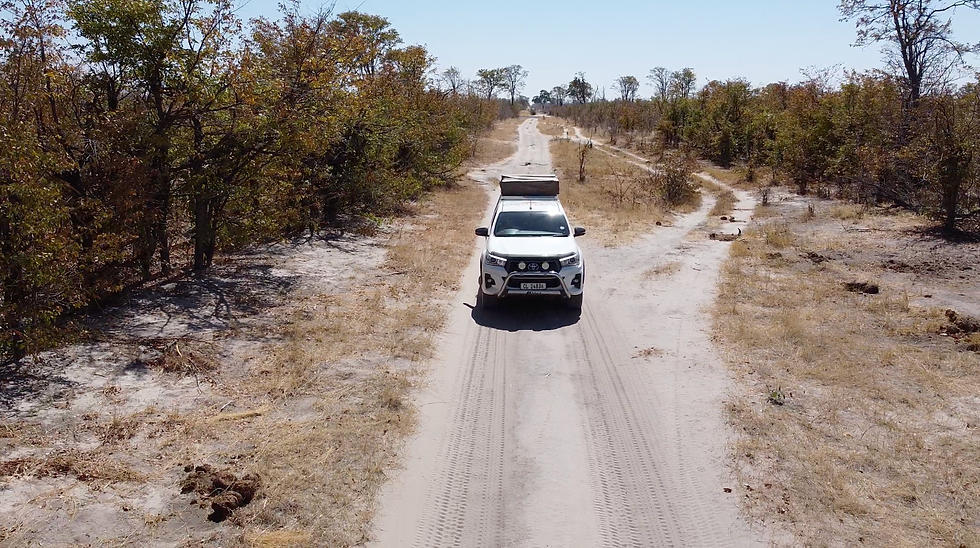
Because here you very quickly go from a normal road into an environment where you really need to be able to drive a 4x4 .
Botswana Tourism Organisation explicitly points out that remote areas and national parks are often only accessible by four-wheel drive vehicles and that self-drivers should expect rough terrain and deep sand. ( Botswana Tourism)
And deep sand is something you shouldn't just try with a normal rental car.

Why do you need 4x4 experience in Botswana?
Imagine you're driving on a dirt track. The sand gets deeper.
You notice that the vehicle is making more difficult progress.
Many inexperienced drivers are now doing exactly the wrong thing:
They accelerate more. This can cause the tires to dig in deeper and deeper.
What you need instead are:
correct speed
Feeling for the vehicle
correct tire pressure
controlled acceleration
correct gear selection
Knowledge of the 4x4 system
Knowing when you need to let air out
Experience with deep sand
And sometimes simply the ability to recognize: I'd better not drive any further here.
No 4x4 experience?
Then you don't need to remove Botswana from your list.
We can schedule 4x4 training and a detailed vehicle briefing before the trip.
Among other things, you will learn:
how your 4x4 system works
when you use 4H and 4L
how to deal with deep sand
how to adjust tire pressure
how to safely move a vehicle through difficult terrain
how to behave in the event of a flat tire
how you drive the vehicle on different surfaces
After that, you can set off much more safely.
Nevertheless, it's true that training cannot replace years of off-road experience.
Therefore, we plan the route according to your experience.
An experienced 4x4 driver may take a different route through Botswana than someone who has just completed their first training.

South Africa: Self-drive with exceptional freedom
South Africa is probably the most versatile country for self-drive holidays in our portfolio.
For example, you can:
Cape Town → Winelands → Garden Route → Addo
drive.
Or:
Johannesburg → Panorama Route → Kruger
Or:
Cape Town → Little Karoo → Karoo → Eastern Cape
Or you can combine a classic tour with a private safari.
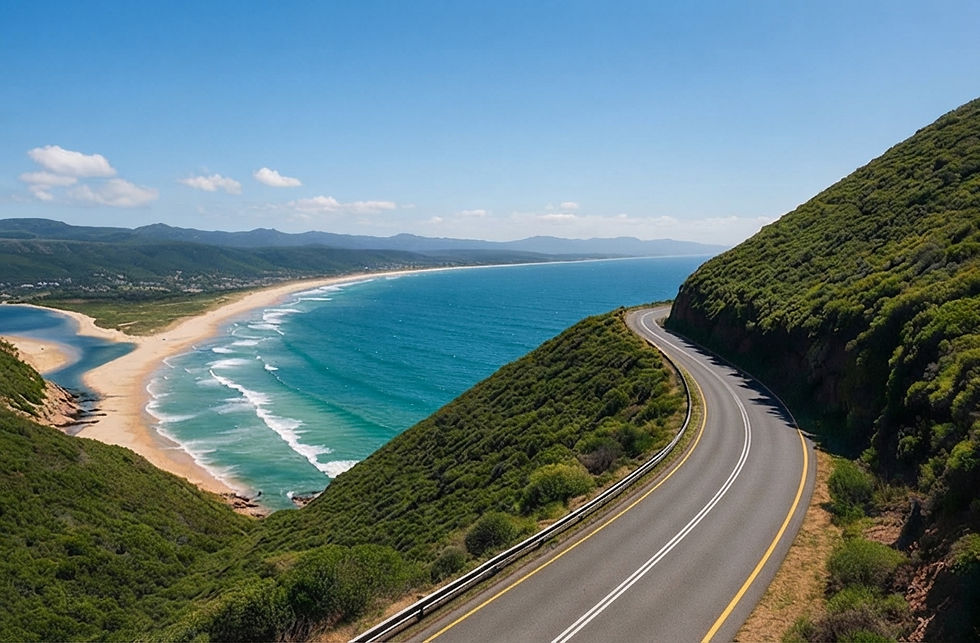
The main roads are generally well-maintained, and many tourist regions can easily be explored with a standard rental car. Within Kruger National Park, the tourist roads are either paved or well-maintained gravel roads. Speed limits there are significantly lower than outside the park, depending on the road type. SANParks recommends an average speed of around 30 km/h on tourist roads, which offers both greater safety and better opportunities for wildlife viewing. Therefore, you don't necessarily need a 4x4 for classic self-drive routes in South Africa. Of course, this is different for certain remote regions or specific 4x4 trails.
Why don't we offer self-drive in every country?
This question is absolutely justified.
We offer trips to many African countries:
Kenya
Tanzania
Uganda
Rwanda
Zambia
Zimbabwe
Mozambique
Mauritius
Zanzibar
Namibia
Botswana
South Africa
However, that doesn't mean we recommend self-drive everywhere.

Kenya
Kenya can generally be explored by rental car.
For a classic safari through regions like the Masai Mara, we would usually prefer a guided tour.
Why?
The combination of road conditions, navigation, wilderness areas, and the fact that a good safari guide makes a huge difference in wildlife viewing, often makes a guided safari the better option for us.
Tanzania
You can also drive yourself in Tanzania.
However, for a safari in the Northern Circuit, we would normally use an experienced safari guide.
Especially in the Serengeti and the Ngorongoro region, it's not just about getting from A to B.
The goal is to find wild animals and to read their behavior.
A good guide knows where to look and how to position himself when he spots something.
That makes a big difference.
Uganda and Rwanda
For many trips here, the focus is not solely on driving.
Gorilla and chimpanzee trekking, national parks and guided activities make an experienced local guide particularly valuable.
Therefore, we currently offer these destinations primarily as guided tours.
Zambia and Zimbabwe
Both countries are ideally suited for classic safari trips.
However, remote regions and national parks also present challenges such as difficult road conditions, long distances and sometimes very limited infrastructure.
Therefore, we currently prefer to rely on local guides and reliable transfers, rather than simply handing you a rental car and sending you into the wilderness.

Mozambique
Mozambique can be an exciting destination for a road trip.
However, road quality, distances and infrastructure vary greatly depending on the region.
For our trips, we currently want to ensure that transfers and activities function reliably.
Therefore, we are currently focusing more on guided tours and private transfers.
Mauritius
Mauritius is generally a very good country for car rentals.
The island is small and the infrastructure is good.
We can therefore also plan individual trips with rental cars.
Mauritius is of course not a destination for a classic safari self-drive trip, because the island is not comparable to the major safari countries.
Which vehicle do I need?
That depends on the trip. We generally distinguish between:
Standard rental car
Ideal for:
cities
Coastal
wine regions
well-developed roads
classic round trips
SUV: More comfort and ground clearance. Ideal for many South Africa trips and certain Namibia routes.
4x4: Our preferred choice for more demanding Namibia trips and a prerequisite for many Botswana routes.
4x4 with roof tent
For classic camping self-drives. You have your bed, your camping equipment and most of your supplies directly in the vehicle.

What makes a good 4x4?
You shouldn't just look at the price of the rental car. We also pay attention to other factors, including:
suitable all-terrain tires
at least one full-size spare wheel
Ideally, a second spare wheel for remote routes.
jack
Tool
compressor
Tire repair kit
Towing equipment
ample storage space
Refrigerator
Camping equipment
Navigation option
GPS or offline navigation
Communication options
sufficient range
On a true wilderness trip, the vehicle's equipment is part of the trip planning.
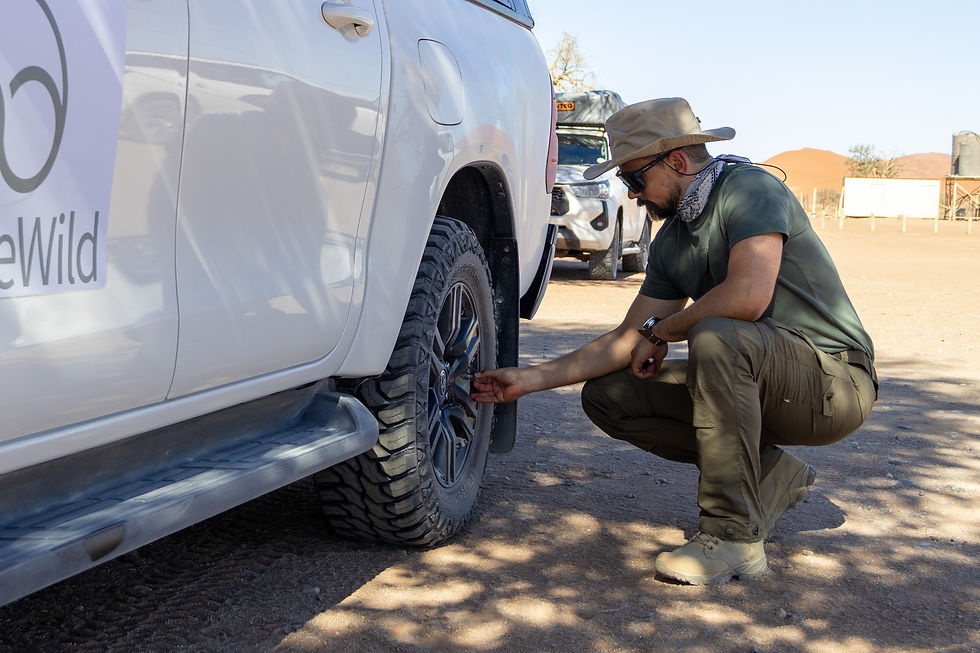
Tire pressure: A small detail with great importance
Correct tire pressure is not unimportant on a self-drive vehicle.
You drive with a different tire pressure on asphalt than on gravel or sand.
On corrugated metal surfaces, slightly adjusting the tire pressure can improve driving comfort.
In deep sand, letting air out of the tires can be crucial.
This increases the tire's contact area and allows the vehicle to "float" better on the sand.
But:
Lower tire pressure is not automatically better.
Too little air can also cause damage.
Therefore, during the vehicle briefing, we will show you which tire pressure is appropriate for your vehicle and the respective surface.
And at least as important:
You must be able to inflate the air again afterwards.
Therefore, a compressor is essential equipment for appropriate 4x4 trips.
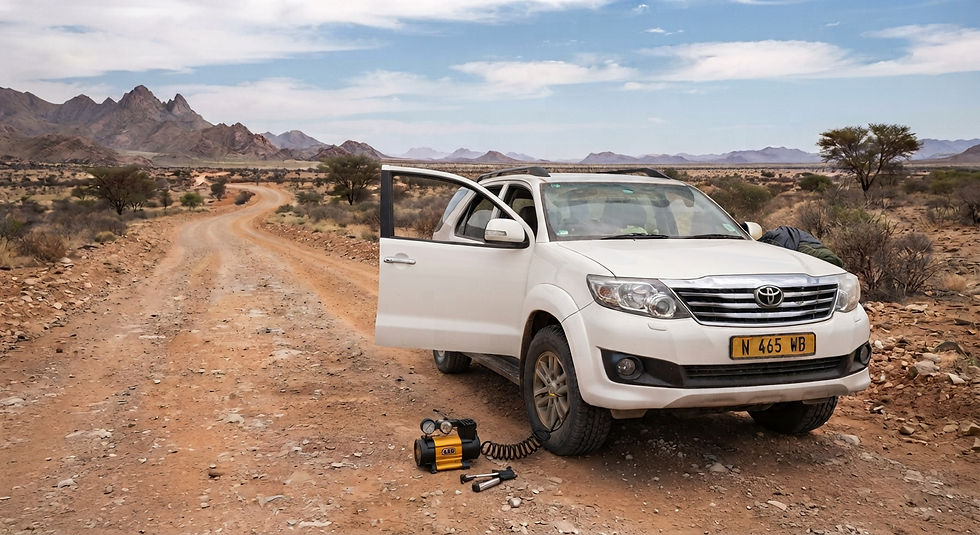
What happens in the event of a flat tire?
A flat tire in the middle of Namibia or Botswana sounds like a pretty bad day.
But it doesn't have to lead to the trip being cancelled.
Our car rental partners are prepared for vehicles to travel in remote regions.
You will receive instructions on the vehicle and emergency equipment upon handover.
And if something does happen, you have someone to contact.
Depending on the situation, our local partner can:
come to you
to change a tire
Bring spare parts
organize a replacement vehicle
rescue you from a difficult situation
coordinate the rest of the journey
That's one of the reasons why we don't just book self-drive through any cheap car rental company.
We want to know who's on the other end of the phone number when you're out in the bushes.
What happens if the car can no longer drive?
This is an important difference between a good and a bad self-drive organization.
A vehicle can have a technical defect despite the best preparation.
Or you drive through a particularly difficult section and damage a tire or a part of the suspension.
Then it's not about telling you on the phone:
"Good luck."
Our partner network is designed to provide support in case of emergency.
If on-site repair is not possible, a vehicle exchange can be arranged depending on the situation.
That means:
You don't have to cancel your entire trip just because your rental car has a problem.
What do I do if I get stuck in the sand?
First:
Stop accelerating.
This is one of the most common mistakes.
The longer you let the tires spin, the deeper you dig yourself in.
Depending on the situation, the following steps may help:
Secure the vehicle.
Check tire pressure.
Release the air accordingly.
Remove sand from in front of the tires.
Level the roadway if possible.
Start off with controlled acceleration.
Use sand ladders if available.
Request support if needed.
And that's precisely why vehicle familiarization is so important.
You shouldn't be experiencing this situation for the first time if your car is already stuck up to the axle in the sand.
Navigation and behavior in road traffic
Navigation: Google Maps is not always enough
In remote regions, you shouldn't rely solely on a regular online map.
Mobile phone reception may fail.
Roads cannot look the way they are shown on the map.
And a seemingly shortcut can turn out to be a very bad idea.
We therefore recommend:
Offline maps
reliable navigation systems
GPS
current route information
saved accommodations
sufficient battery
Power bank
ideally a second navigation option
Especially in Botswana, you shouldn't spontaneously change your route based on the motto "it looks shorter on the map".
Gas stations: Plan your range
One of the most important rules for self-drive holidays in Africa: If you see a petrol station and your tank is not full, fill up.
You don't always know when the next one will appear. Especially in Namibia and Botswana, the distances between supplies can be considerable. For remote camping routes, you must also plan for sufficient water and food. The Botswana Tourism Organisation explicitly recommends carrying adequate supplies of water and fuel, as well as spare parts and at least one spare tire, for remote self-drive camping trips. On our planned trips, we already take such distances into account when planning the route.
How far can I drive in one day?
Here, less is more.
A common mistake in self-drive travel is to include too many kilometers in the route.
A 400-kilometer journey on a European motorway can be relatively relaxed.
On a gravel road in Namibia, 400 kilometers can be a full day of travel.
And in Botswana, a significantly shorter route can take considerably longer due to sand and difficult terrain.
Therefore, we don't just plan based on kilometers.
We look at:
Road conditions
Subsoil
expected speed
Breaks
Wildlife observations
Fueling facilities
daylight
Check-in times
border crossings
Weather
Driving experience


Animals on the street
In Africa, self-drive also means:
You share the road with animals.
Elephants can cross the road. Giraffes suddenly appear beside the track. Antelopes run in front of the vehicle.
And in some regions, lions or other wild animals can be very close to the road.
Therefore, special rules apply in the national park.
In Botswana, for example, you are not allowed to simply drive off the designated tracks in national parks. The tourism organization explicitly points out the importance of adhering to the existing tracks and speed limits.
And of course, the following applies:
Wild animals always have the right of way.
Am I allowed to simply get out of the car in the national park?
No.
This is a point you need to take very seriously on a self-drive safari.
Although you are driving, you are still in a habitat with wild animals.
You are relatively safe inside the vehicle.
Outside the vehicle, completely different rules apply.
You may only get off where it is explicitly permitted.
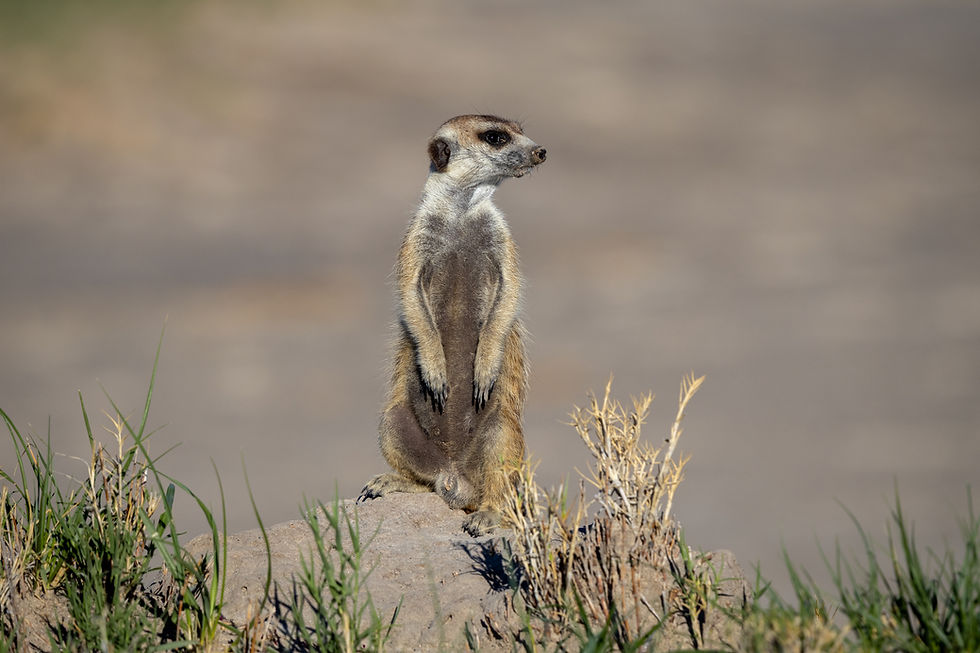
Self-drive safari: Can I see animals just as well?
That depends on what you expect.
If you drive in Kruger yourself, you can experience fantastic sightings.
You are free and can decide for yourself where to stop.
But an experienced guide has one crucial advantage:
He knows the region. He recognizes traces.
He knows where animals frequently congregate. He listens to radio transmissions.
And he can often assess what's going on more quickly.
Therefore, a combination of self-drive and guided safari can be particularly exciting.
The combination we particularly like
For example, you drive through Namibia yourself. You explore the landscape. You stay in lodges. You camp under the stars. And at the end of your trip, you spend a few days in a private game reserve with an experienced guide.
Here's how you get:
Freedom + comfort + a true safari experience.
Or you can combine a self-drive safari in South Africa with a few days in a private safari lodge.
You don't have to choose just one type of travel.
Lodge or rooftop tent.
Lodge-Self-Drive
Ideal if you:
You want comfort
you don't want to camp
You have long driving days
If you want a proper bed in the evening
travel independently anyway
would like
You drive yourself, but you don't have to worry about camping.
roof tent
Ideal, wenn du:
-
Abenteuer möchtest
-
unabhängiger sein willst
-
gerne draußen bist
-
abgelegene Campingplätze spannend
findest
-
näher an der Natur sein möchtest
Du hast dein eigenes kleines Zuhause auf dem Dach.
combination
For many travelers, this is the best solution.
A few nights of camping.
Then Lodge again.
Then back to camping.
This way you get to experience both sides of Africa.
Things to know about self-drive safaris
What's included in a rooftop tent safari?
That depends on the vehicle and the provider.
These can typically include:
roof tent
mattress
Sleeping bags
Camping chairs
Camping table
Dishes
Cutlery
Cooking utensils
Gas or camping stove
Refrigerator
water canister
Camping lighting
Basic equipment for the vehicle
Before the trip, we will clarify exactly what equipment your vehicle comes with.
Do I need to have camping experience?
Not necessarily.
But you should be prepared to embark on a somewhat more authentic journey.
Setting up a rooftop tent isn't rocket science.
After one or two nights, you'll usually understand the process quickly.
More important are:
organization
clean packing
Water planning
Food planning
Weather
Security
Handling the vehicle
And of course, a certain degree of adventurous spirit.
What about rain?
Rain can drastically alter Self Drive in some cases.
A gravel road that is easily passable in dry weather can suddenly become difficult or even impassable after heavy rainfall.
Mud. Water.
Washed out slopes. River crossings.
Therefore, the following applies: A route is not the same all year round.
We take the season and the respective regional conditions into account when planning.
And if a route is not feasible due to the weather, we will change the route.
What about river crossings?
In Botswana and some other remote regions, watercourses or seasonal floodplains may be part of the route.
Extra caution is required here.
You should never simply drive through an unknown body of water just because someone has driven through it before you.
Water depth, seabed and current can change.
For challenging routes, it is therefore necessary to clarify beforehand whether the route is currently passable.

Why we prefer to organize your rental car ourselves
You can of course book a rental car yourself.
However, we almost always recommend booking through us.
Not because we just want to sell you any old car.
But because it keeps everything connected.
We know:
your route
your accommodations
your planned activities
your routes
your vehicle
your rental car partner
your local contacts
If something changes, five different companies don't need to communicate with each other.
An example
Imagine you have a flat tire on a trip to Namibia and therefore arrive at your lodge two hours late.
Once we have fully organized your trip, we or our local partner can inform the lodge.
You don't have to explain why you're late.
Or a road is impassable due to weather conditions.
Then we can adjust the route together with the local partner and, if necessary, inform the next accommodation.
That is the real added value of a well-organized self-drive.
You drive yourself. But you're not on your own.
How much does a self-drive tour cost?
The rental car is only one part of the total costs.
These include, for example:
Accommodation
campsites
fuel
Parking fees
National park fees
Activities
Transfers
Insurance
Border fees
possible one-way fees
Catering
Depending on the vehicle and provider, camping equipment and sometimes additional fees may apply to rooftop tent trips.
Therefore, we calculate the trip as a complete package and not just based on the cheapest rental car price.


Do I need an international driving permit?
That depends on the country and the specific car rental company.
We check the requirements for your trip in advance and tell you which documents you need.
It is also important that you have your driver's license and the required vehicle documents with you during the trip.
Driving on the left
In all three self-drive destinations in our portfolio, you drive on the left side of the road.
This applies to:
South Africa
Namibia
Botswana
If you've only ever driven on the right before, it will feel unusual at first.
You usually get used to it after a short time.
The following is particularly important at the beginning:
When turning, consciously think about which side you need to continue driving on.
How difficult is self-driving really?
Our honest assessment:
South Africa
Easy to medium difficulty. Very good for beginners.
Namibia
Moderate. Not technically difficult, but long distances and gravel roads require concentration.
Botswana
Moderate to challenging. Depending on the route, some sections are technically demanding, and deep sand makes it significantly more challenging.
Therefore, for our Botswana self-drive tours, we require appropriate 4x4 experience or organize training and a thorough briefing.
Who is Self Drive suitable for?
Self Drive is perfect for you if you:
enjoys traveling independently
You are not afraid of long journeys
You like to make your own decisions
If you want to experience landscapes intensely
You like to travel off the beaten track
are flexible
Do you like adventures?
you want to deal with a 4x4
you like to drive yourself

Self Drive is less suitable if you:
You don't like driving long distances
You quickly feel uncomfortable on unfamiliar streets
you don't feel like dealing with gravel or sand
you want to organize as little as possible
Exclusively luxury accommodations and short transfers preferred.
Then a guided tour is probably the better choice.
And what if you're unsure?
Then you don't have to commit to a complete self-drive trip right away.
We can also combine them.
For example:
South Africa Safari and Cape
→ 3 days in Cape Town
→ 5-day self-drive
→ 3-day private safari
Namibia Road Trip
→ 2 nights rooftop tent
→ 2 nights at a lodge
→ 3-night safari
Botswana 4x4 Self-Drive
→ 4x4 Training
→ Self Drive
→ Private lodge safari to conclude
Self-drive is not just one way to travel through Africa.
It's a way to experience Africa.
You decide when to stop.
You can stop at a red dune even though it is not mentioned in any travel guide.
You can watch an elephant crossing the road.
You can open your rooftop tent in the morning and look directly out into the distance.
And sometimes you won't meet anyone for miles on a long gravel road.
That's precisely the appeal. You're not just on the go. You're right in the middle of it.
And yet you don't have to forgo safety, good planning and support.
We make sure your self-drive experience isn't just about renting a car and following a Google Maps route.
We plan the vehicle, route, accommodations, activities and local support as a shared experience.
Our self-drive destinations

Frequently asked questions about self-drive in Africa
Not suitable for every route. However, we recommend it for many of our trips due to its ground clearance, comfort, and safety on gravel roads.
Yes, depending on the route. We then select routes and accommodations that are suitable for the respective vehicle.
A 4x4 vehicle is required for national parks, remote areas, and many safari routes. ( Botswana Tourism )
Yes, if we schedule appropriate 4x4 training and a thorough vehicle briefing, and if the route suits your experience level.
You should know how your vehicle and emergency equipment work. We will explain the most important steps to you during the handover.
For challenging 4x4 routes, a compressor is very important, especially when the tire pressure needs to be adjusted for sand and then increased again.
You contact your local representative. Depending on the situation, our car rental partners can come to you, change a tire, arrange repairs, or provide a replacement vehicle.
If the vehicle cannot be repaired on site, a replacement vehicle will be organized depending on the situation.
Stop accelerating. Secure your vehicle, assess the situation, and call for assistance if necessary. On our Botswana tours, we explain how to react in such situations beforehand.
Yes. We can plan self-drive trips with rooftop tents, lodge accommodations, or a combination of both.
No. However, you should be prepared for a somewhat more rustic trip. Basic camping equipment will be explained and checked together with you.
Yes. That's actually one of our preferred combinations.
Yes, with a suitable route and proper instruction. However, for particularly challenging off-road tracks, you should have relevant experience or choose a guided 4x4 tour. ( Visit Namibia )
With the right preparation, a suitable vehicle, and realistic route planning, self-drive tours are quite feasible in our destinations. It's important not to underestimate the conditions and to adhere to the rules in national parks and protected areas.
Because the vehicle, route, accommodations, and local support are all perfectly coordinated. In case of problems, we or our local partner can react more quickly and, for example, inform accommodations about delays.

Your self-drive experience doesn't begin with the vehicle handover.
He starts with the planning.
Which country?
Which route?
What time of year?
Which vehicle?
Which tires?
Lodge or rooftop tent.
How much experience do you have?
How many kilometers do you want to drive per day?
Where are the gas stations?
Where do you need a 4x4?
And where is it better to leave the car and continue with an experienced guide?
These are precisely the questions that transform a rental car holiday into a genuine African journey.
We plan your self-drive tour so that you get the freedom you are looking for, without unnecessarily putting yourself in situations you cannot assess.
You are in the driver's seat.
We make sure you know where you're going.