
Safari with kids
Experiencing Africa as a family

At what age is a safari a good idea?
There is no universally "right" safari age.
A two-year-old child can theoretically go on a safari, while a very active eight-year-old child may be significantly less enthusiastic than their parents after three hours in the vehicle.
Therefore, the following are crucial:
-
Old
-
attention span
-
temperament
-
Travel experience or safari experience
-
Length of the journeys
-
Accommodation
-
Type of safari
-
planned activities
Especially with younger children, the trip should be planned around the child, and not the child around the trip. Many lodges also have their own age limits. These can vary considerably. Some accept children of all ages, others only allow game drives from the age of six, while still others set the limit at eight, ten, or twelve years. Private vehicles can sometimes circumvent these restrictions, but this must always be confirmed individually with the lodge.

Our favorite safari countries for families
We wouldn't recommend every country from our portfolio equally for every age group. A safari with young kids has different requirements regarding route, accommodation, transfers, and activities than a trip with teenagers. Some destinations offer particularly family-friendly lodges and short distances, while others can be more challenging due to long drives, remote camps, or age restrictions for certain activities.
Therefore, what matters is not just the destination, but above all how the trip is planned. We pay attention to suitable accommodations, sufficient time between activities, and a route that suits the age of your kids and your family's expectations.
Our portfolio is particularly suitable for families:

South Africa
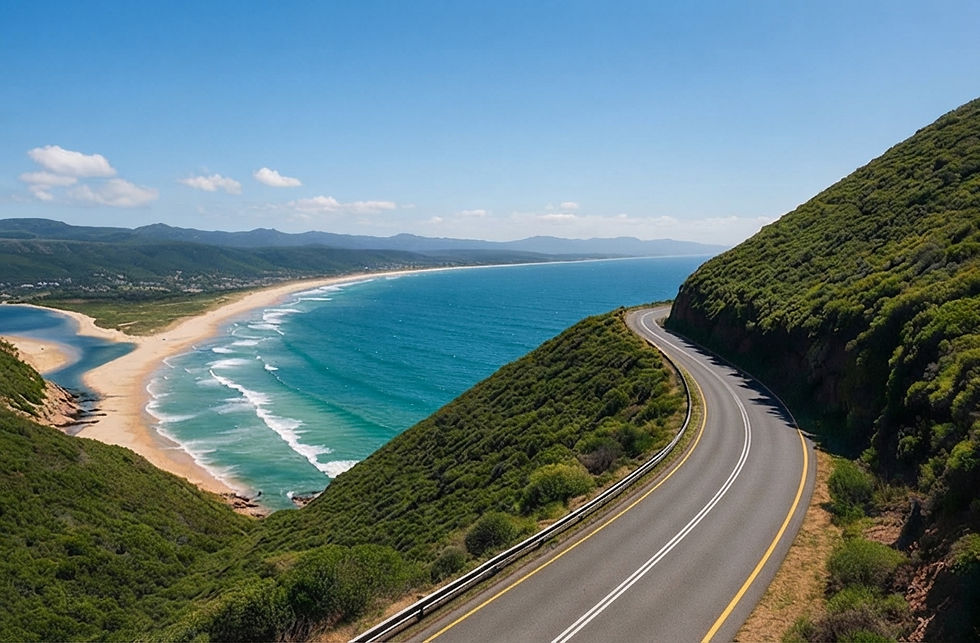
South Africa offers the greatest flexibility. You can combine a safari with Cape Town, the Garden Route, the Winelands or the coast, and drive many routes yourself with a rental car.
Malaria-free safari areas like the Eastern Cape or Madikwe are particularly interesting. Kruger and Greater Kruger are also options, but the specific lodge and its policies regarding kids must be checked.
For families with young kids, South Africa is often the easiest way to get started in Africa.

Kenya
Kenya is excellent for families who want to experience a classic safari.
The Masai Mara offers a high density of wildlife and therefore good chances for exciting sightings without having to search for animals for hours.
The combination of safari and coastline also makes Kenya very attractive.
Another advantage: Many family-friendly camps cater to kids and offer age-appropriate activities.


Why do you need 4x4 experience in Botswana?
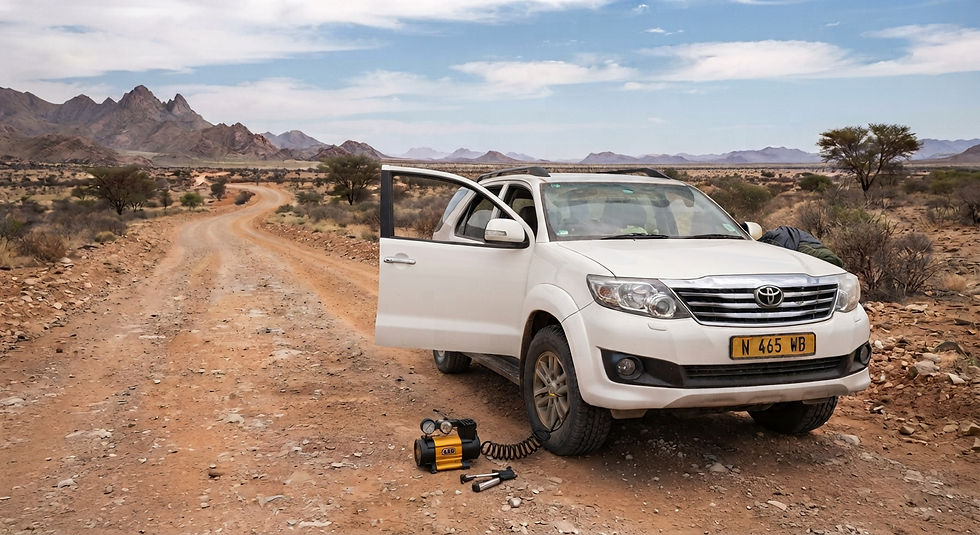
Imagine you're driving on a dirt track. The sand gets deeper.
You notice that the vehicle is making more difficult progress.
Many inexperienced drivers are now doing exactly the wrong thing:
They accelerate more. This can cause the tires to dig in deeper and deeper.
What you need instead are:
correct speed
Feeling for the vehicle
correct tire pressure
controlled acceleration
correct gear selection
Knowledge of the 4x4 system
Knowing when you need to let air out
Experience with deep sand
And sometimes simply the ability to recognize: I'd better not drive any further here.
Botswana
Botswana is a fantastic family destination for kids aged six to eight and up.
Why not earlier?
Many safari lodges are small, remote, and designed for intense wilderness experiences. These often include long game drives, charter flights, and, depending on the region, activities such as mokoro trips or walking safaris.
But for older children, this can be incredibly exciting.
Botswana isn't so much the classic "first safari with toddlers," but rather a fantastic choice for families who want to truly immerse themselves in the wilderness together. Many lodges have their own age limits, and a private vehicle may be necessary for younger kids.


Namibia
Namibia is particularly interesting for families who want to combine a safari and a self-drive tour.
The vast landscapes, excellent road infrastructure, and the opportunity to travel independently make the country very flexible.
For example, a trip could combine Sossusvlei, Swakopmund, Damaraland and Etosha.
This is especially convenient with children, because you can determine your own daily rhythm.
Our recommendation by age
Old
0–3 years
4–6 years
7–9 years
10–14 years
15+ years
Especially suitable
South Africa, selected family-friendly lodges
South Africa, Kenya, selected Tanzania routes
South Africa, Kenya, Tanzania, Namibia, Botswana
Botswana, Tanzania, Kenya, Zambia, Zimbabwe, Uganda
All destinations including gorilla trekking
This is intentionally only a guideline. The lodge and the specific travel itinerary are just as important as the country.
Zambia and Zimbabwe
Both countries are great safari destinations, but we wouldn't automatically put them first for younger children.
They are particularly suitable for families with older children and teenagers who already have an interest in nature and wildlife.
Walking safaris, canoe trips and more intensive bush activities can then become real highlights.

Uganda and Rwanda
These two countries are fantastic for families with older children, especially if primates are a focus of the trip.
For a classic family safari, Uganda and Rwanda are somewhat different, as the famous gorilla treks are only permitted for those aged 15 and over. In Uganda, the minimum age for chimpanzee trekking is 12. These regulations are binding.
However, this does not mean that Uganda is unsuitable for younger children.
On the contrary: boat safaris, classic game drives and nature experiences can work extremely well.
Getting around with a child
How long should the journeys be?
This is probably one of the most important points to consider when planning a family safari. An adult can spend four hours on a game drive and still be fascinated. A five-year-old, on the other hand, might suddenly find everything else more interesting after 45 minutes.
Therefore:
Don't plan for the maximum journey time, but rather for the child's maximum attention span.
With younger kids, we try to avoid long journeys or plan them so that they can be broken up by interesting stops. A trip with many short journeys is usually better than one where five or six hours are spent in the vehicle every other day.
I'd rather fly than drive.
In countries like Botswana, Tanzania, Zambia, and Zimbabwe, domestic flights between safari areas can be an excellent solution. A 15- to 45-minute charter flight can be far more comfortable for a family than two to six hours on a bumpy bush road.
Especially when traveling with young kids, the price of a transfer shouldn't be the only factor considered. Time is just as valuable as money on a family safari.

Do you need your own safari vehicle?
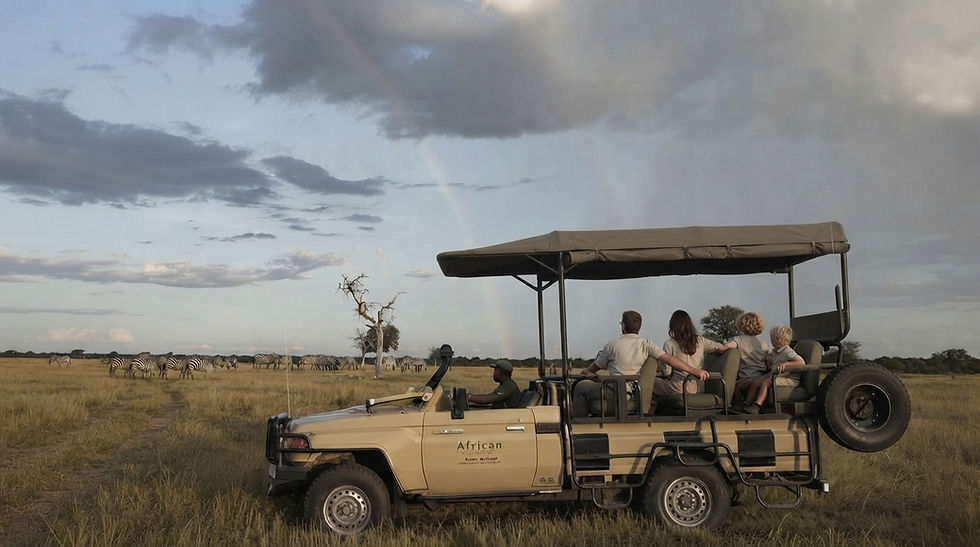
Our clear answer: For younger children, often yes. A private vehicle is one of the best investments a family can make on safari. With a private vehicle, it's just your family, your guide, and possibly a tracker in the car.
That means:
You set the rhythm.
Is the child tired? You go back.
The child wants to stay longer with the elephants? You can stay.
You only want to do a two-hour morning game drive? No problem.
You want to take a break? You can schedule it in.
Why a Shared Game Drive can be more difficult
When sharing a vehicle, the guide must consider all guests. If another couple insists on staying with a leopard for another 30 minutes, that can be a very long time for a three-year-old child.
Conversely, the other family might already want to return to the lodge while your ten-year-old child is experiencing their first wild dog sighting. A private vehicle therefore gives you flexibility and peace of mind.
Many lodges relax their age restrictions for exclusive vehicle use. However, this must always be confirmed before booking. Some lodges only allow children aged 6 and over on shared game drives, while others have no age restrictions or restrictions up to 12 years old.

Does every child need their own seat?
In a safari vehicle, each child should have their own seat, just like in a car. Toddlers and infants can be carried in a carrier or held on a lap. Even more important is the question of child car seats and restraint systems. Here, there are significant differences between regular transfers, rental cars, and open safari vehicles. Rental cars in southern Africa have specific regulations regarding children and child restraint systems. A suitable child car seat is mandatory for children under three years old; older children must also use appropriate restraint systems or seat belts.
However, the situation is different with a classic safari vehicle. Open game drive vehicles simply do not have a child seat.
That's why we clarify the following in advance for every family trip:
-
Age and size of the child
-
Type of vehicle
-
existing straps
-
Availability of a child car seat
-
Option to bring your own seat
-
Lodge safety regulations
When traveling by car, a child seat should always be reserved in advance and confirmed in writing. We would never rely on the assumption that "a child seat will somehow be available."
Safari Lodges with kids
The choice of lodge can completely change a family trip. A beautiful lodge is not automatically a good family lodge.
Therefore, we pay attention to, among other things:
-
Family rooms or family suites
-
interconnecting rooms
-
private villas
-
private vehicles
-
children's programs
-
Babysitting
-
shorter game drives
-
Pools
-
age-appropriate activities
-
flexible meal times
-
Children's meals
-
Care provided by trained staff
What do kids do between game drives?
This is a point that parents often underestimate when planning. A typical safari day doesn't consist of eight hours of wildlife viewing. Usually, there's a game drive in the morning and another in the afternoon.
In between, there is time for:
-
Lunch
-
pool
-
To read
-
Sleep
-
Draw
-
Games
-
Nature activities
-
Observation at the waterhole
Good family lodges consciously utilize this time.
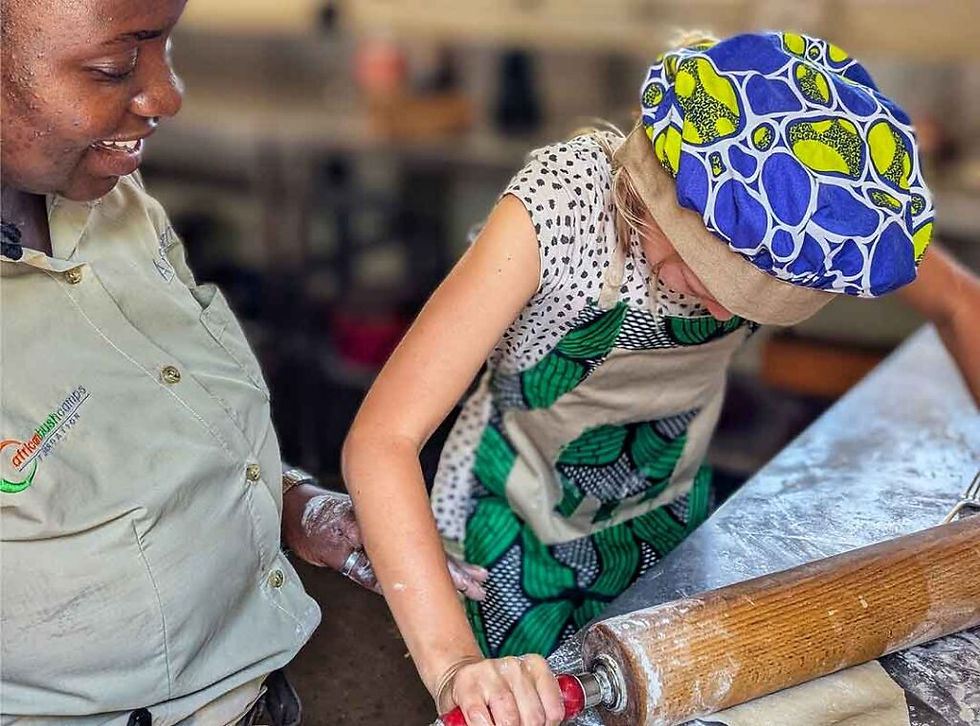
Kids programs
A good kids' program at the lodge can make a safari much more exciting for children.
Instead of just sitting in the vehicle, children learn, for example:
-
Reading animal tracks
-
Identifying plants
-
Identifying insects
-
birdwatching
-
to make a fire
-
to learn about traditional crafts
-
to learn something about local cultures
-
simple survival techniques
For us, the best kids' program is not one that simply "keeps children busy." It should bring them closer to Africa.
Some lodges offer activities such as bush walks, tracking, bug identification, and other age-appropriate activities.


What happens when it rains?
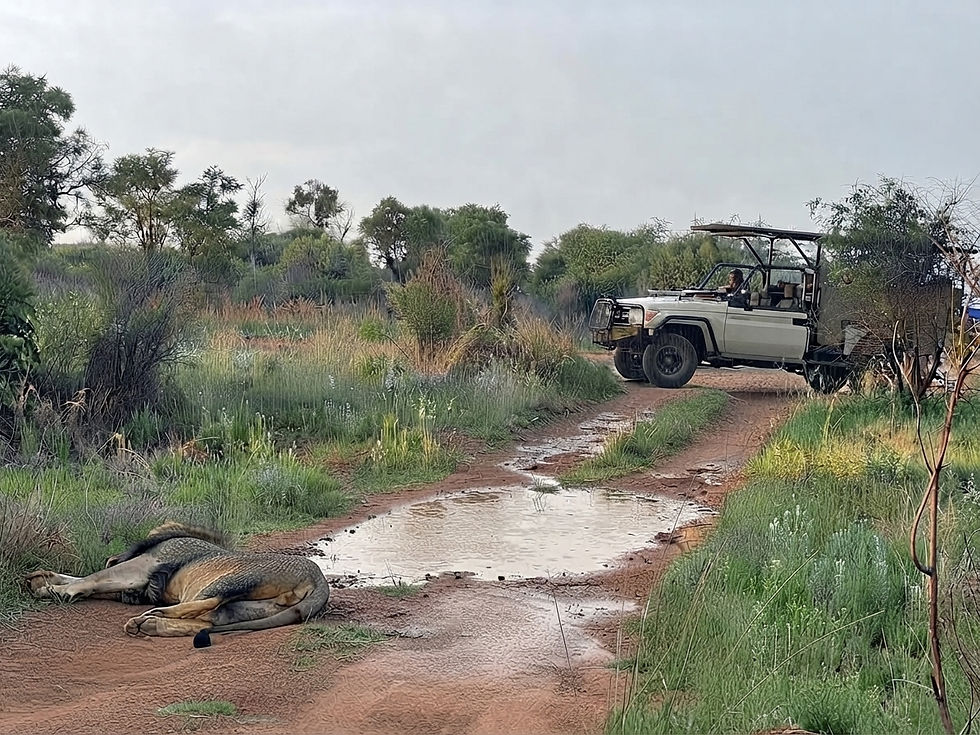
Rain on safari is no reason to panic. On the contrary: a safari in the rain can be spectacular.
Dramatic clouds, fresh greenery, wet elephants, and the sounds of the bush create a completely different atmosphere. But with children, you should have a plan B.
Depending on the lodge, alternatives may include:
Baking or cooking
Arts and crafts activities
Junior Ranger Programme
board games
Nature lessons
Movie nights
library
Spa for parents
Pool, when the weather clears up again
And of course: pack a rain jacket.
Safari with babies and toddlers
A safari with a baby is generally possible, but we would plan it differently than a safari with older children.
The following are important:
short transfers
minimal changes of accommodation
good medical infrastructure
family-friendly accommodation
private vehicles
flexible daily planning
Babysitting
suitable sleeping arrangements
Access to drinking water and food
sufficient shade
Regions that can be easily combined with other child-friendly travel components are therefore particularly attractive.
South Africa is often the easiest choice here due to its infrastructure and wide range of accommodation options.
Safari and beach
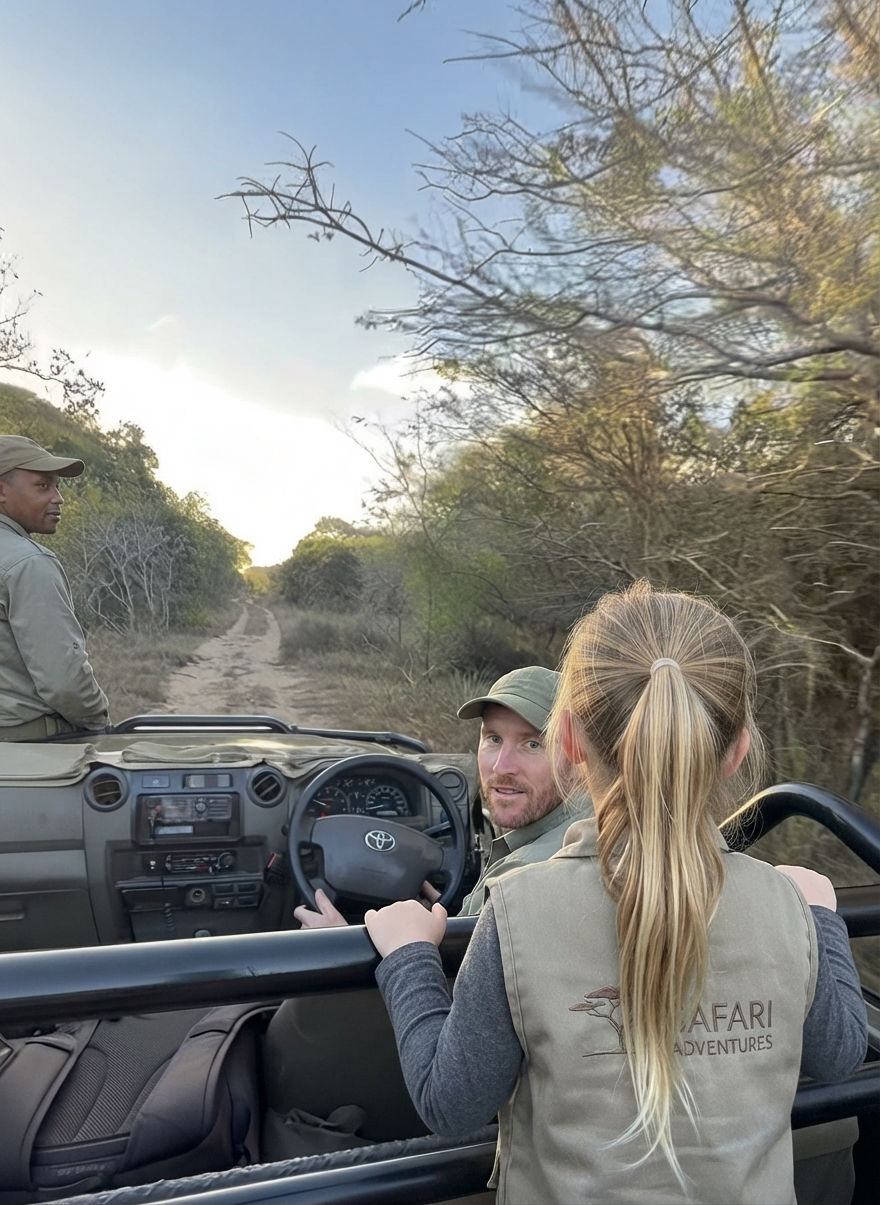
A safari doesn't have to be the entire trip. Especially with children, a combination of safari and beach is often ideal. After three or four days in the bush, a few relaxing days by the sea might be just what's needed.
Combinations like the following are particularly beautiful:
-
Tanzania and Zanzibar
-
Kenya and Diani Beach
-
South Africa and coast
-
Safari and Mozambique
The beach isn't just "relaxation for the parents." Children can swim, snorkel, build sandcastles, and simply enjoy a day without having to get up early.


Gorilla Trekking with kids
The answer here is clear: Unfortunately, no.
Gorilla trekking in Rwanda and Uganda is only permitted for those aged 15 and over. This is not a recommendation from the lodge, but a strict age requirement. Rwanda explicitly states 15 as the minimum age, as does the Uganda Wildlife Authority. Therefore, for families with younger children, we would not recommend planning a trip solely around gorilla trekking. Uganda offers plenty of other fantastic experiences.
Chimpanzee trekking with kids
The situation is slightly different here. In Uganda, the minimum age for chimpanzee trekking is 12 years.
This means: Under 12 years of age: no classic chimpanzee trekking.
For younger children, other primate observations and nature experiences may be possible, depending on the region. Here too, the following applies: We do not plan the trip around a single activity if the child cannot participate due to their age.
Safety on safari with children
A safari is very safe if properly planned. But children need to understand that a safari camp is not a zoo. Animals can move around freely, and big cats like leopards can jump over fences.
Therefore, clear rules apply:
Never leave your accommodation alone.
Always follow the guide's instructions.
Do not feed the animals.
Do not shout or deliberately provoke animals.
Only one employee should be out at night.
Stay seated in the vehicle.
These rules can actually be exciting for children. "You're not allowed to do that" becomes: "You're now part of the safari team."

Frequently asked questions about safaris with kids
This depends heavily on the destination, lodge, and activity. Some lodges accept toddlers, while others set a minimum age of six, eight, ten, or twelve years.
From our point of view, South Africa is the most flexible choice, especially malaria-free regions and family-friendly reserves.
Not automatically, but usually not. This needs to be clarified with the lodge and provider beforehand. For rental cars, a suitable child seat should definitely be reserved in advance.
Yes. Which vehicle depends on the lodge and the child's age. Some lodges only allow younger children in a private vehicle.
Only from age 15 in Rwanda and Uganda.
In Uganda the minimum age is 12 years, in Rwanda, as with gorilla trekking, it is 15 years.
Good lodges offer indoor and outdoor activities. Rain can also be a fantastic safari experience.
Good lodges offer indoor and outdoor activities. Rain can also be a fantastic safari experience.
Malaria and Health
Health planning should be considered early on when planning a family safari. The risk of malaria varies greatly depending on the region and time of year. For families with very young children, a malaria-free safari region in South Africa can therefore be particularly attractive. If a trip leads to a malaria area, individual prophylaxis should be discussed early with a doctor experienced in travel medicine. Vaccinations, sun protection, insect repellent and a well-equipped travel pharmacy are also part of the preparation.
Which safari is suitable for which child?
For small kids
South Africa and Namibia
Short journeys, good infrastructure and plenty of family-friendly accommodation.
For kids from about 6 years old
Kenya and Tanzania
Classic safari, high animal density and plenty of options for families.
For kids aged approximately 8 years and older
Botswana
More wilderness, longer journeys and extraordinary safari experiences like mokoro.
For teenagers
Zambia, Zimbabwe, Uganda and Rwanda
This is especially interesting if children already have a genuine interest in nature, photography, hiking or wildlife.
Ages 15 and up
Gorilla Trekking
Now Rwanda and Uganda become particularly interesting.
Our most important recommendation
If you're going on safari with kids, don't just plan the same trip you would take as a couple, only with kids in the vehicle.
A family safari should be structured differently.
Fewer changes of accommodation. Shorter journeys.
More free time. Family-friendly lodges.
Age-appropriate activities.
And if you have small children, preferably use a private vehicle.
The goal isn't to get up at 5 a.m. every morning and search for animals until sunset. The goal is for your child to say at the end of the trip:
"When can we go back to Africa?"
Why is a tailor-made family safari a good idea?
This is precisely the difference between a pre-arranged family trip and an individually planned safari. We don't just look at which country you want to visit. We look at your family.
How old are the children?
How long can they sit in the car?
Do they need a nap?
Which animals interest them?
Would you like to swim?
Do they enjoy being active?
Would you like to take the photos yourself?
And how much safari is really enjoyable for you as a family?
The route is determined by these answers. Not the other way around.


Your family safari starts here
A safari with kids doesn't have to be more complicated.
It needs to be better planned.
We select the destination, regions, lodges and activities to suit the age of your children and your expectations as a family.
Whether it's a first safari with small children in South Africa, a classic Big Five trip in Kenya, the Okavango Delta with older children, or gorilla trekking with teenagers:
We are planning our trip to Africa in such a way that the whole family can enjoy it.
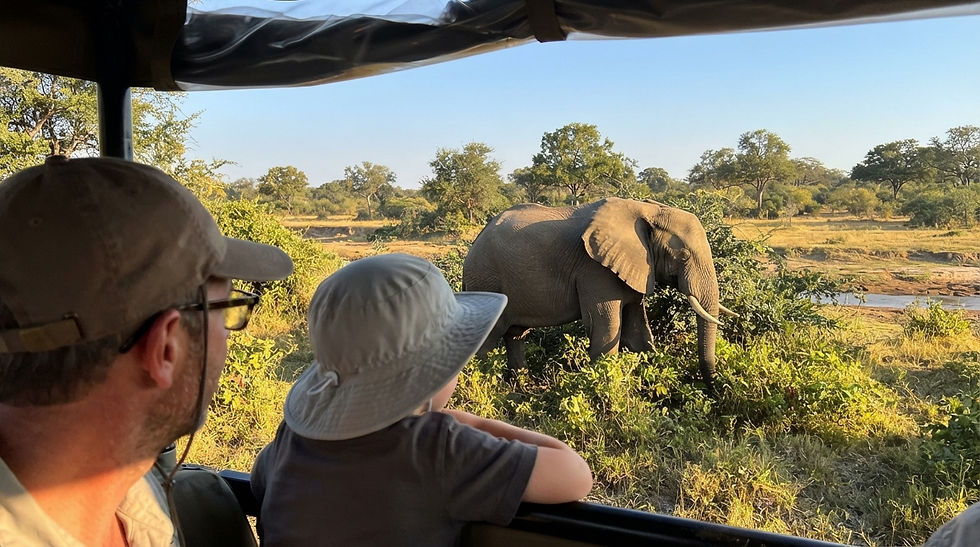
A safari with kids can be one of the most formative family trips ever. The first elephant your child sees from the open safari vehicle. A lion lying in the grass just a few meters away. A rhino suddenly appearing from behind a bush. Or the moment when, after two hours in the bush, your child suddenly spots a small gecko and finds it more exciting than the Big Five.
That's precisely what makes a family safari so special. But a safari with kids doesn't automatically work on the same principles as a safari for adults. The right country, the right lodge, short driving distances, a suitable daily itinerary, and above all, the right expectations make a huge difference.
A good family safari, therefore, doesn't try to see as many animals and parks as possible in the shortest amount of time. It gives kids time to discover Africa in their own way.